
Home › How to Claim
How to Claim the UAE R&D Tax Credit: A Step-by-Step Guide
The UAE R&D Tax Credit offers qualifying businesses a non-refundable credit on eligible research and development expenditure, using a tiered rate structure of 15%, 35%, and 50%, applied to qualifying expenditure of up to AED 5 million per tax period. The maximum credit value under Phase 1 is AED 2 million.
But knowing you qualify is only half the equation. You also need to get the claim right: the right documentation, the right pre-approval, and the right filing process.
This guide walks you through the five steps from eligibility confirmation to filing with the Federal Tax Authority, with references to Cabinet Decision No. 215 of 2025 and Ministerial Decision No. 24 of 2026 throughout.
Legislative basis: MD 24, Article 2(1) (rates and spend cap); MD 24, Article 2(2) (non-refundable).
Eligibility vs Claiming: Two Different Things
Many businesses conflate confirming eligibility with actually making a claim. Knowing you qualify is step one. The claiming process, which covers documentation, pre-approval, calculation, and FTA filing, is an entirely separate workstream that takes months, not days. This guide covers the claiming process. For eligibility, see our eligibility checker.
Step 1: Confirm Your Eligibility
Before you invest time in documentation and pre-approval, confirm that your business and your R&D activities meet the four eligibility gates.
Gate 1: Entity type
You must be a UAE juridical person (including Free Zone entities) or a foreign entity with a Permanent Establishment in the UAE. Entities that have elected Small Business Relief or are not subject to UAE Corporate Tax cannot claim.
CD 215, Article 1; CD 215, Article 4
Gate 2: Activity type
Your R&D activities must be novel, creative, uncertain in outcome, systematic, and transferable or reproducible, assessed by reference to the OECD Frascati Manual.
MD 24, Article 3(1)(a)–(e); MD 24, Article 3(2)
Gate 3: Minimum expenditure
Your qualifying R&D expenditure must be at least AED 500,000 per R&D project within the tax period. This threshold applies to each individual project, not as a cumulative total across all projects. The threshold is calculated on base qualifying expenditure before the 30% staff cost uplift is applied. A project with AED 400,000 of actual staff costs does not meet the threshold even after the uplift takes the calculated amount to AED 520,000. The minimum is tested against actual underlying expenditure.
CD 215, Article 5(3)(b)
Gate 4: Conducted in the UAE
The R&D activities must be carried out in the UAE. MD 24, Article 3(3) Subcontracting fees qualify as expenditure where the subcontractor is UAE-based, activities are performed in the UAE, and no chain subcontracting occurs. MD 24, Article 10(1) There is no percentage cap on qualifying subcontracting fees.
Not sure if you qualify? Our eligibility page walks you through each gate in detail, with an interactive checklist.
Not sure if you qualify? Check your eligibility in detail.
Step 2: Document Your R&D Activities
Documentation is where most claims succeed or fail. The UAE framework requires you to maintain a structured dossier that covers three areas: technical eligibility, financial evidence, and methodology.
The Three-Part Documentation Dossier
Part 1: Technical Eligibility File
This demonstrates why your activities qualify as R&D under UAE tax rules. For each R&D project, you need:
Your technical narrative should be aligned to the Frascati Manual criteria. If you are unsure whether an activity qualifies, the test is straightforward: could a competent professional in your field have predicted the outcome without conducting the research? If yes, it is not R&D. If no, it likely qualifies.
Part 2: Financial Defence File
This evidences the cost base underpinning your claim. You need:
Cost Contribution Arrangement contributions MD 24, Article 11: Where a Qualifying Entity participates in a Cost Contribution Arrangement with other parties to jointly develop R&D, its proportionate arm’s-length contribution qualifies as Qualifying R&D Expenditure, provided the R&D activities are performed in the UAE. This category is relevant for multinational groups sharing R&D costs across jurisdictions.
Capitalised R&D costs CD 215, Article 5(1)(f): Where any of the above expenditure categories (staff costs, consumables, subcontracting, CCA contributions) are capitalised as internally generated intangible assets under the applicable accounting standards, for example under IFRS IAS 38, those capitalised costs still qualify as Qualifying R&D Expenditure. The credit is not lost simply because the costs appear on the balance sheet rather than the income statement. IFRS preparers should ensure their qualifying expenditure analysis covers both expensed and capitalised R&D costs.
Note: capital equipment and equipment depreciation are not qualifying expenditure categories under the UAE regime and must not be included in the claim. CD 215, Article 5(1)
The 2-6-14 Staffing Threshold
Ministerial Decision No. 24 of 2026 introduced a tiered staffing requirement that directly affects your credit rate. The rates are marginal: applied to portions (bands) of qualifying expenditure, not to the total qualifying expenditure as a flat rate:
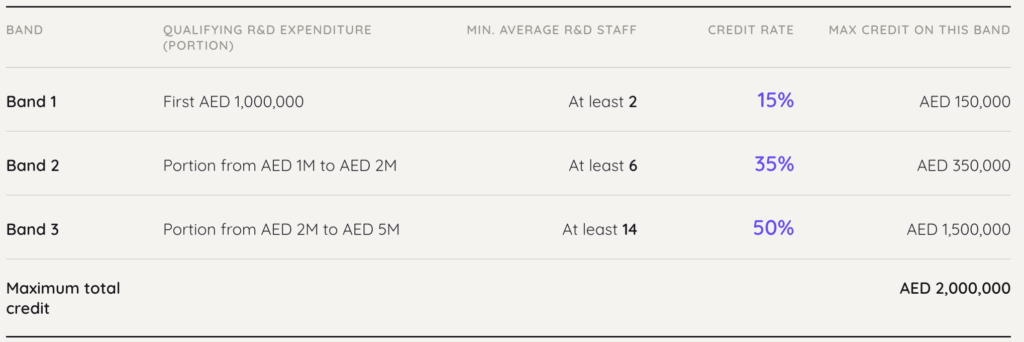
Both thresholds must be met for each band: the expenditure threshold AND the staff threshold must be satisfied simultaneously. If your staff count does not reach the threshold for a band, that band’s rate does not apply and the expenditure in that band attracts no credit. MD 24, Article 2(7)
Example: A company with AED 3M qualifying spend but only 10 R&D staff receives credit on the first AED 2M only (Bands 1 and 2, where 10 staff meets the 6+ threshold), and zero credit on the remaining AED 1M (Band 3 requires 14+ staff).
Legislative basis: MD 24, Article 2(1) (rate table); MD 24, Article 2(7) (dual threshold rule).
The 30% Staff Cost Uplift also applies: when calculating your qualifying expenditure, eligible staff costs are uplifted by 30% before the credit rate is applied. MD 24, Article 8(3)
This means your financial documentation must clearly identify each R&D staff member, their role, their time allocation to qualifying projects, and their cost to the business.
Externally Provided Workers: A Distinct Planning Category
Externally Provided Workers (EPWs) are a category defined in MD 24, Article 8(9). An EPW is an individual who:
This distinction matters enormously for planning purposes:
EPW planning example: A company has 4 direct R&D employees and engages 4 agency scientists through a staff provider company, all working under the company’s supervision and direction on qualifying R&D projects. With EPWs correctly classified, the company has 8 qualifying R&D staff (meeting the Band 2 threshold of 6+) rather than 4 (Band 1 only). If those 4 EPWs cost AED 600,000, classifying them correctly as Staff Costs rather than subcontracting fees also means an additional AED 180,000 in uplift (AED 600,000 × 30%) flows into the qualifying expenditure calculation.
Part 3: Methodology File
This explains how you calculated the claim:
Record Retention
All documentation must be retained for at least seven years from the end of the relevant tax period and provided to the Emirates R&D Council and/or the Federal Tax Authority upon request. MD 24, Article 12(1)
Digital storage is acceptable, but records must be readily accessible and organised by project and tax period.
Need help structuring your documentation? Talk to our team.
Record Retention
All documentation must be retained for at least seven years from the end of the relevant tax period and provided to the Emirates R&D Council and/or the Federal Tax Authority upon request. MD 24, Article 12(1)
Digital storage is acceptable, but records must be readily accessible and organised by project and tax period.
Need help structuring your documentation? Talk to our team.
Step 3: Apply for Emirates R&D Council Pre-Approval
Unlike many international R&D tax credit regimes, the UAE system is not purely self-assessed. You must obtain pre-approval from the Emirates Research and Development Council (ERDC) for each R&D project before you can claim the credit on your tax return. MD 24, Article 4(1); CD 215, Article 3(1)(b)
What the Council Assesses
The ERDC evaluates whether your project meets the definition of a Qualifying R&D Activity. Specifically, they assess:
The Council does not assess the commercial viability of your project, only its technical eligibility as R&D.
What to Submit
Your pre-approval application should include:
Practical Preparation
Start the pre-approval process early in the tax period, ideally within the first quarter. The Council may request additional information or clarification, and you do not want the pre-approval timeline to delay your tax filing.
If you have multiple R&D projects, each project requires its own pre-approval application. Batch your submissions where possible, but ensure each application is self-contained with its own technical narrative and cost estimate.
Current Status
The ERDC pre-approval process is being established as part of Phase 1 of the R&D Tax Incentives Programme. The Council’s application portal, submission deadlines, and review timelines will be published on the ERDC website. We recommend monitoring the Council’s announcements and beginning your documentation preparation now so you are ready to submit as soon as the portal opens.
Read our full Emirates R&D Council pre-approval guide.
Step 4: Calculate and Claim the Credit
Once you have pre-approval and your documentation dossier is complete, you can calculate the credit.
The Credit Rates
The R&D Tax Credit is calculated on a banded (marginal) basis. The rate applied to each portion of qualifying expenditure depends on both the spend level reached and your average R&D staff headcount:
Both the spend threshold and the staff threshold must be met simultaneously for each band to apply. MD 24, Article 2(7) The maximum credit is AED 2,000,000 per tax period.
The 30% Staff Cost Uplift
Before applying the credit rate, eligible staff costs are uplifted by 30%. This means if your R&D staff costs are AED 1,000,000, they are treated as AED 1,300,000 for the purposes of calculating the credit. MD 24, Article 8(3)
See worked example: AED 451,000 credit on AED 1.86M qualifying spend →
Scenario: A UAE technology company with 8 qualifying R&D staff members incurs the following expenditure in a tax period:
Step 1: Apply the 30% staff cost uplift to eligible staff costs.
The uplift applies to Staff Costs only, not to consumables or subcontracting fees. MD 24, Article 8(3)
AED 1,200,000 × 1.30 = AED 1,560,000
Step 2: Calculate total qualifying expenditure after uplift.
AED 1,560,000 (staff with uplift) + AED 150,000 (consumables) + AED 70,000 (software licences) + AED 80,000 (subcontracting) = AED 1,860,000 total qualifying expenditure
Step 3: Determine applicable credit bands using the dual threshold test.
With 8 R&D staff:
Step 4: Apply banded (marginal) rates to the qualifying expenditure:
Step 5: Check against the maximum credit cap.
The maximum credit is AED 2,000,000. AED 451,000 is well within this limit.
Result: The company receives an AED 451,000 non-refundable tax credit against its UAE Corporate Tax liability. MD 24, Article 2(1); Article 2(7); Article 8(3); Article 2(2)
Planning note: If this company grows its R&D team to 14 qualifying staff and increases qualifying expenditure to over AED 2M, Band 3 becomes available. Both thresholds, spend and headcount, must be met simultaneously for each band, making the staffing level a meaningful operational planning point.
Estimate your own R&D Tax Credit.
Applying the Credit
The R&D Tax Credit is applied first against your UAE Corporate Tax liability, then against any Top-up Tax liability (for multinational groups subject to Pillar Two). CD 215, Article 6(1); MD 24, Article 2(2)
Carry-Forward Rules
If your R&D Tax Credit exceeds your Corporate Tax liability, the unused portion carries forward to future periods. However, two conditions govern this:
Condition A: Ownership continuity MD 24, Article 5(1)(a): The same persons must have continuously owned at least 50% of the Qualifying Entity from when the credit arose to when it is used.
Condition B: Business continuity exception MD 24, Article 5(1)(b): If ownership changes by more than 50%, the carry-forward still survives if the entity continues to conduct the same or a similar Business or Business Activity (assessed under the factors in Article 39(2) of the Corporate Tax Law). This is the critical safeguard for startups: a Series A or Series B round that dilutes founders below 50% does not automatically forfeit accumulated credits, provided the business continues its R&D-led activities. However, this should be assessed before the transaction closes, not after.
Listed company exemption MD 24, Article 5(2): Entities whose shares are listed on a Recognised Stock Exchange are exempt from the ownership continuity test entirely.
For startups: The carry-forward strategy still works: accumulate credits now, use them when profitable. But if you are approaching a funding round that will change ownership by more than 50%, take specific advice before closing to confirm the same-business exception applies to your circumstances.
Step 5: File with the Federal Tax Authority
The R&D Tax Credit claim is submitted as part of your annual Corporate Tax Return filing with the Federal Tax Authority (FTA).
What to Include in Your Filing
Your tax return must include:
Integration with Corporate Tax Return
The R&D Tax Credit is not filed as a separate application: it is integrated into your Corporate Tax Return. CD 215, Article 9(2) This means your tax adviser or finance team needs to:
Compliance and Audit Readiness
The FTA may request additional information or conduct an audit of your R&D Tax Credit claim. To be audit-ready:
Filing Timeline
Your R&D Tax Credit claim is filed with the same deadline as your Corporate Tax Return, within 9 months of the end of your tax period. For a standard calendar-year tax period (January–December 2026), the filing deadline would be 30 September 2027.
Do not leave the R&D Tax Credit preparation to the final weeks before filing. The documentation requirements are substantial, and the pre-approval process with the ERDC has its own lead time.
Ready to start? Book a consultation.
Your Claiming Timeline
Calendar Year 2026 tax period:
Identify qualifying R&D projects. Begin documenting activities in real time. Assign R&D staff to projects with clear time-tracking.
Prepare and submit ERDC pre-approval applications for each R&D project. Allow time for Council review and any follow-up requests.
Maintain contemporaneous records: project logs, time sheets, financial records, testing results. Do not try to reconstruct documentation after the fact.
Review qualifying expenditure against the AED 500,000 minimum threshold per project. Confirm staffing tier for the credit rate. Begin assembling the documentation dossier.
Finalise the three-part documentation dossier. Calculate the credit. Prepare the R&D Tax Credit schedules for the tax return.
File the Corporate Tax Return with the FTA, including the R&D Tax Credit claim and all supporting documentation.
Retain all records for a minimum of seven years from the end of the tax period (i.e., until at least 31 December 2033 for the 2026 tax period).
Common Mistakes to Avoid
1. Reconstructing documentation after the fact
The most common and most costly mistake. If you wait until filing time to write up your R&D technical narratives and gather financial evidence, you will miss details, produce weaker documentation, and increase your audit risk. Document as you go: contemporaneous records are always more credible than retrospective ones.
2. Misunderstanding what counts as R&D
Not all innovation qualifies. Routine product development, cosmetic improvements, and process optimisation that does not involve genuine scientific or technological uncertainty do not meet the Frascati Manual criteria. If a competent professional in your field could have predicted the outcome, it is not R&D.
3. Failing the staffing threshold
The 2-6-14 rule is not optional. If you claim the 35% Band 2 rate but only have 5 qualifying R&D staff, your qualifying expenditure above AED 1M attracts no credit because the Band 2 threshold (6+ staff) is not met. Ensure your staff count is evidenced with employment contracts, time allocation records, and project assignments. (MD 24, Article 2(7))
4. Including grant-funded expenditure
Expenditure that has been funded by government grants or subsidies cannot be included in your qualifying R&D expenditure base. If a project receives partial grant funding, you must exclude the grant-funded portion from your claim. (CD 215, Article 5(3)(d))
5. Ignoring the pre-approval requirement
The UAE requires pre-approval from the Emirates R&D Council before you can claim. If you file a claim without pre-approval, it will be rejected. Start the pre-approval process early. (MD 24, Article 4(1))
6. Claiming below the minimum threshold
If your qualifying R&D expenditure is below AED 500,000 per project in a tax period, that project cannot be claimed. Monitor your expenditure throughout the year to ensure you will meet the per-project threshold. (CD 215, Article 5(3)(b))
7. Poor time allocation for dual-role staff
Many R&D staff split their time between qualifying R&D activities and other work. If you cannot evidence what percentage of their time was spent on R&D, with contemporaneous time sheets, not retrospective estimates, the FTA may disallow the staff cost entirely. (MD 24, Article 8(7))
8. Free Zone migration after claiming credits
MD 24, Article 16(2) contains the most severe financial consequence in the entire regime. If a Qualifying Entity claims R&D Tax Credits and then, within five years of the last claim, becomes a Qualifying Free Zone Person (QFZP), every dirham of utilised credits is clawed back as Payable Tax. Unutilised credits are forfeited. There is no ability to offset this liability against other tax losses or credits. For UAE-incorporated companies operating near Free Zones, or considering redomiciliation to DIFC, ADGM, Dubai Silicon Oasis, or any other Free Zone, this is a strategic decision, not an administrative one. The five-year window runs from the last claim, not from the first. Take specialist advice before any Free Zone migration if your business has claimed or intends to claim R&D Tax Credits.
Frequently Asked Questions
How do I claim the UAE R&D Tax Credit?
You claim the R&D Tax Credit as part of your annual Corporate Tax Return filing with the Federal Tax Authority. Before filing, you must obtain pre-approval from the Emirates R&D Council for each R&D project and prepare a three-part documentation dossier covering technical eligibility, financial evidence, and calculation methodology.
What is the minimum R&D expenditure required to claim?
Your qualifying R&D expenditure must be at least AED 500,000 per R&D project within the tax period. This threshold applies to each project individually, not as a cumulative total across all projects. CD 215, Article 5(3)(b)
Do I need pre-approval from the Emirates R&D Council?
Yes. Pre-approval is mandatory for each R&D project. You must submit your project to the Emirates R&D Council and receive approval before including it in your tax return claim. This is a distinctive feature of the UAE regime: unlike the UK or Australian systems, it is not purely self-assessed.
What credit rate will I receive?
The rates are marginal (banded), not a flat rate on your total qualifying spend. The 15% rate applies to the first AED 1,000,000 of qualifying expenditure (requires 2+ R&D staff). The 35% rate applies to qualifying expenditure between AED 1M and AED 2M (requires 6+ R&D staff). The 50% rate applies to qualifying expenditure between AED 2M and AED 5M (requires 14+ R&D staff). Both the spend and the staff threshold must be met simultaneously for each band. Eligible staff costs also receive a 30% uplift before the credit rate is applied. MD 24, Article 2(1); Article 2(7); Article 8(3)
Can I carry forward unused R&D Tax Credits?
Yes. If your R&D Tax Credit exceeds your tax liability in a given period, the unused portion can be carried forward to future tax periods. CD 215, Article 6(3); MD 24, Article 5 This is particularly relevant for startups and early-stage companies with limited taxable income.
How long do I need to keep R&D documentation?
All R&D documentation must be retained for at least seven years from the end of the relevant tax period. MD 24, Article 12(1)
What happens if my claim is audited by the FTA?
The FTA may request additional documentation or explanations. If your three-part dossier is complete and contemporaneous, and your ERDC pre-approval is in place, you will be well-positioned to respond. Ensure your R&D staff are available to explain the technical narrative and that your financial records are reconciled.
Can contractors and agency workers count as R&D staff for the UAE R&D Tax Credit?
Yes. Contractors and agency workers can qualify as Externally Provided Workers (EPWs) under MD 24, Article 8(9), provided they are not directors or employees of the Qualifying Entity, they provide services through a staff provider company or as an independent contractor, they are personally obliged (not substitutable) under contract, and their services do not constitute subcontracting. EPW costs attract the 30% overhead uplift and count toward the 2/6/14 staffing thresholds, making them a valuable planning category for businesses with flexible workforces.
Ready to Start Your Claim?
The R&D Tax Credit is live for tax periods starting 1 January 2026. The businesses that prepare their documentation and pre-approval applications now will be the ones that claim successfully.
RDvault helps UAE companies structure, document, and maximise their R&D Tax Credit claims, drawing on deep experience with R&D tax incentives in the UK and internationally.
